The Three Payload Numbers
The only payload number that matters for the Tune M1 is the one on your driver's door sticker, not the advertised payload on the manufacturer's website, and not GVWR minus curb weight from the internet. Your door sticker payload is your truck's actual, individual capacity as it left the factory. Most M1 owners need at least 1,000–1,200 lbs of door sticker payload to run a comfortable build with gear, water, and passengers.
There are three "payload numbers" people commonly use, but only one is correct:
Two Tacomas sitting on the same dealer lot, same year, same trim level, can have different door sticker payloads. One ordered with a tow package, upgraded audio, and a moonroof weighs more from the factory than one without. More curb weight means less payload. The advertised number doesn't reflect this. Your door sticker does.
Why the Door Sticker Is the Only Number That Matters
The Certification/Tire and Loading Information label on your door jamb isn't a suggestion. It's a federally mandated certification issued under 49 CFR Part 567 by the National Highway Traffic Safety Administration (NHTSA). The payload figure on it is the manufacturer's legally certified maximum load for your specific vehicle.
What that means in practice:
- It's VIN-specific. It was calculated from your truck's actual curb weight as it rolled off the line, including every option, package, and accessory your truck was built with.
- It accounts for what's actually on your truck. Every factory-installed option adds curb weight. The sticker number already reflects this. The internet spec sheet doesn't.
- It's the number insurance and legal proceedings use. If you're in an accident and there's any question of overloading, the door sticker payload is the reference point. "But the GVWR math says..." is not a defensible position in court or with an adjuster.
Your door sticker is on the inside of the driver's door frame. Open the door and look at the edge or jamb. The payload figure is labeled "Combined Weight of Occupants and Cargo Should Never Exceed" followed by a number in pounds (and sometimes kilograms). That number is your limit.
The GVWR Debate: Addressing It Directly
This comes up constantly in truck camper communities. The argument goes: "My door sticker says 1,200 lbs but my GVWR is 6,305 lbs and my truck weighs 4,652 lbs, so my real payload is 1,653 lbs. The sticker is just conservative."
It's a reasonable-sounding argument. Where it breaks down:
The 4,652 lb curb weight figure is from Toyota's website. It's a baseline for a specific configuration, not your truck. The moment your truck was built with options that differ from that baseline, the number is wrong for your vehicle.
Your door sticker uses your truck's actual measured curb weight. That's the number Toyota used when they calculated and certified your payload. The discrepancy between "GVWR math" and your sticker isn't Toyota being conservative. It's that your truck is heavier than the spec sheet baseline.
From an enforcement standpoint, weigh stations and DOT officers do weigh total vehicle weight against GVWR and GAWR. They don't compare item-by-item against your payload sticker. But this doesn't make the sticker number "optional." Exceeding your sticker payload means you're eating into the margin between your truck's loaded weight and its GVWR. At some point those numbers converge, and that's when a scale matters. The sticker is the early warning system.
The practical risk isn't a ticket. It's stopping distance, tire failure, and emergency handling at highway speed, all of which degrade before you ever see a scale.
You can make your own decisions about how much weight you carry. Many people run over their door sticker payload without incident. But don't confuse "I've done it fine" with "the limit isn't real." The limit is real. It's just that consequences aren't always immediate. Use your door sticker number. It's the only one that was calculated for your specific truck.
The Sneaky Weight Items Nobody Accounts For
Even people who know to use their door sticker number often underestimate how fast payload gets used up. These are the items that consistently surprise people when they actually model their build. Component weights are broken down on the batteries, water systems, and mattresses pages.
| Item | Weight | Why People Miss It |
|---|---|---|
| Full fuel tank | 100–140 lbs | Fuel weighs ~6.3 lbs/gallon. A Tundra's 22-gallon tank = 138 lbs. A Tacoma's 21-gallon tank = 132 lbs. People think of "the truck" as a fixed weight, but it's not. |
| Passengers | 150–200 lbs each | 150 lbs is the standard planning figure, but most adults weigh more. Two passengers at 175 lbs each = 350 lbs before you've loaded a single piece of gear. |
| Fresh water | 8.34 lbs/gallon | A full 7-gallon jerry can weighs 58 lbs. A 10-gallon tank is 83 lbs. Most people don't count water at all until someone points this out. |
| The camper (base weight) | ~400–500 lbs (M1) | This one people do count, but they forget the next three items above and still end up over. |
| Battery (LiFePO4 100Ah) | ~25–30 lbs | Lighter than AGM, but still adds up. Often thought of as "light enough to not matter." |
| Gear in the cab | ??? | Backpacks, camera gear, tools, dog, food. All of it counts. People often model the camper and forget the cab is also part of the payload equation. |
| Aftermarket accessories on the truck | Varies | Roof rack, bed rack, bumper, skid plates. None of these are in your door sticker curb weight if they were added after purchase. They reduce your usable payload. |
| Relocated spare tire + carrier | ~110–125 lbs | Upsize to 33s or 35s and the bigger spare no longer fits the factory under-bed location. It moves to a hitch-mounted swing-out carrier, and the carrier alone runs ~53 lbs (Wilco HitchGate Solo) before the 60–70 lb spare. All of it hangs behind the rear axle, the worst spot for a payload-tight build. |
The math adds up fast. A realistic Tacoma example:
| Item | Weight |
|---|---|
| Tune M1 (base weight) | ~400 lbs |
| 100Ah LiFePO4 battery | ~28 lbs |
| Mattress (4" foam) | ~20 lbs |
| 7 gallons fresh water | 58 lbs |
| Gear + accessories in camper | ~50 lbs |
| Driver (175 lbs) | 175 lbs |
| Passenger (150 lbs) | 150 lbs |
| Gear in cab (backpacks, etc.) | ~30 lbs |
| Full fuel tank (21 gal) | 132 lbs |
| Total | 1,043 lbs (400 M1 + 643 everything else) |
Before even opening the camper door, 643 lbs of that total has nothing to do with the M1 itself. If your Tacoma's door sticker says 1,200 lbs and the mid-size M1 weighs ~400 lbs, you have 800 lbs left for everything. The example above already accounts for 643 of it, leaving only ~157 lbs for additional gear, food, and accessories. Tighter than most people expect.
How to Calculate Your Real Payload Budget
Find your door sticker
Open the driver's door. Look at the edge of the door or the door jamb. Find the label that says "Combined Weight of Occupants and Cargo Should Never Exceed _____ LBS." Write that number down. That is your budget.
Account for your fuel
At what fill level will you typically drive? If you leave on trips with a full tank, multiply your tank capacity by 6.3 lbs/gallon and subtract it from your budget. This is the step most people skip. For what the M1 does to your actual MPG, see the fuel economy guide.
Count every person
Use actual weights, not 150 lbs as a blanket figure. Two average American adults are closer to 350–380 lbs combined. Subtract this from your remaining budget.
Add your camper and gear to the calculator
Use the M1 Builder payload calculator to model your specific build: the M1 weight, battery, water, mattress, and all your gear. It shows your running total and remaining margin in real time. If you haven't planned the build yet, the interior buildout guide covers what the common layouts weigh.
Don't forget aftermarket accessories
Any accessory added to your truck after purchase (bed rack, roof rack, aftermarket bumper, skid plates) was not included in your factory curb weight. It reduces your usable payload. Add its weight to your total payload draw. For weights of the most common add-ons, see the accessories guide.
The M1 Builder payload calculator handles steps 4–5 for you. Input your truck and it pulls the door sticker payload data, then tracks every item in your build against that limit.
What Being Over Payload Actually Means
The debate in truck communities often centers on tickets and enforcement: "officers check GVWR at the scale, not your payload sticker, so the sticker doesn't matter legally." There's some truth to this from a DOT enforcement perspective. But it frames the wrong risk.
The real risk of exceeding your payload isn't a fine. It's physics.
- Stopping distance lengthens. Overloaded brakes are one of the most dangerous failure modes. The degradation happens before any mechanical failure, at the moment you need to stop hard.
- Emergency handling drops off. At highway speed, a sudden evasive maneuver gets harder when the truck is operating past its design limits.
- Tire failure risk goes up. Overloaded tires run hotter and are more prone to blowouts. On the highway with a loaded truck camper, a rear tire blowout is a serious event.
- Suspension and steering components wear faster. Cumulative. You might not see it on any single trip, but it shows up over time.
None of these consequences announce themselves in advance. That's what makes the payload limit worth respecting: not the sticker itself, but the engineering behind it.
Truck camper insurance
Insurance for the Tune M1 (and most pop-up truck campers) is usually handled as a scheduled-item rider on your truck's auto policy, not as a separate RV policy. The M1 is not self-propelled, doesn't have a VIN, doesn't register as an RV, and is not a tow-behind trailer, which makes it a different category than a Class A motorhome or a travel trailer. Most carriers cover it under personal-property coverage attached to the truck. For the full breakdown, including sample rider wording and what carriers actually asked me, see the M1 insurance guide.
What to ask your carrier
- Is the camper covered while mounted, while removed, or both? Some policies cover the M1 only when mounted on the truck; some only when stored at your home address; the best policies cover it in both states.
- What's the agreed value or replacement cost? You want the policy written for the full replacement value of the M1 plus your build (electrical, mattress, accessories), not the truck's declared value alone.
- Is theft from the truck bed covered? A loaded camper sitting in a parking lot is a target. Confirm what theft scenarios are in scope.
- Are aftermarket accessories included? Solar panels, batteries, 80/20 framing, and 3D-printed parts add real value over time. Some carriers cap accessory coverage at a low number unless you schedule items individually.
- Does the policy cover the camper if you're overweight against your truck's payload? Some policies have payload-compliance language that voids coverage if your truck is loaded over the door-sticker rating at the time of a claim. This is one of the most under-discussed reasons to stay under your sticker. Insurance and liability outcomes are why this guide pushes the door-sticker number so hard.
Carriers that handle pop-up truck campers
The M1 community has had reasonable luck with the following carriers for scheduled-item or rider coverage. Get quotes from at least two before committing; coverage and pricing vary widely by state.
- Progressive. Offers scheduled personal property and some RV-adjacent endorsements for truck-mounted campers.
- State Farm. Personal articles policy can schedule the camper as a rider.
- USAA (for eligible members). Tends to handle non-standard items more flexibly than typical auto carriers.
- National General / Allstate. Have RV products that sometimes accept slide-in and pop-up truck campers.
- Specialty broker. If your standard carrier won't write the rider you need, a specialty RV/marine broker can often place coverage at higher cost.
The site doesn't endorse any one carrier and doesn't earn referral revenue from any of the above. Insurance is local to your state and your driving record; the right answer is whichever carrier writes the coverage you actually need at a price you'll keep paying for years.
A Note on Tacomas Specifically
The Tacoma comes up more than any other truck in payload conversations because it's one of the most popular M1 pairings and one of the most variable in real-world payload capacity. Full trim-by-trim numbers are on the Toyota Tacoma + M1 page. I drive a 2023 TRD Off-Road Access Cab 4WD V6, the truck I'm building toward an M1 install. On June 1, 2026, I took it to a CAT scale to find out what it actually weighs. How I weigh and what I do with the numbers is on the methodology page.
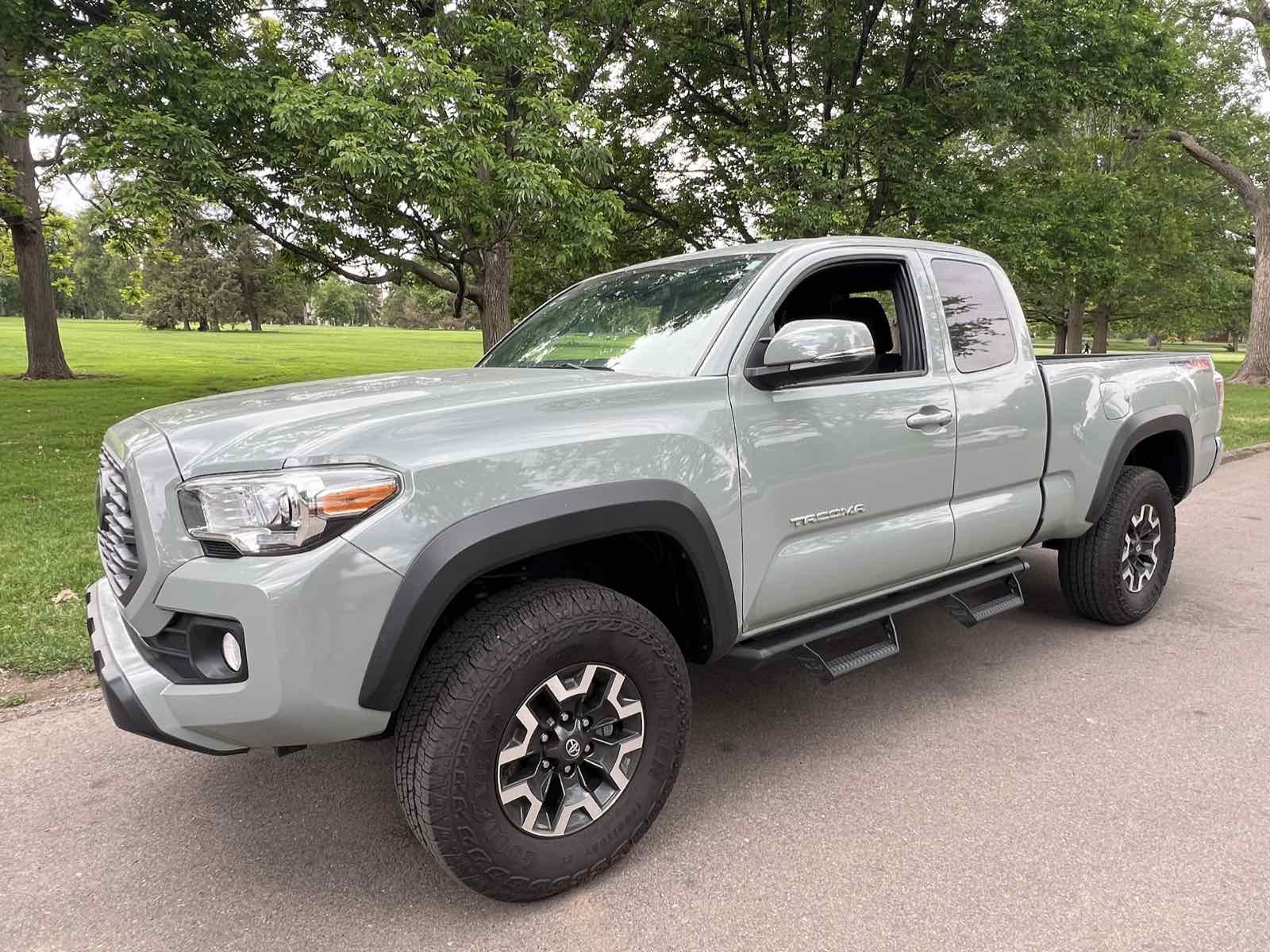
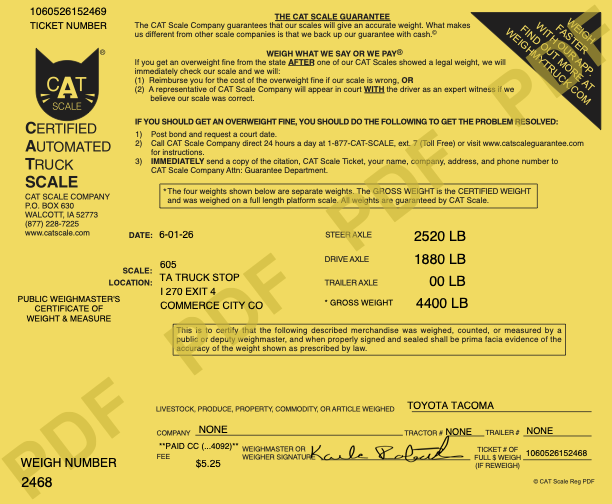
What the scale said (full tank, no driver, stock except factory running boards):
| Axle | Weight |
|---|---|
| Steer (front) | 2,520 lbs |
| Drive (rear) | 1,880 lbs |
| Gross | 4,400 lbs |
What my door sticker says:
| Rating | Limit |
|---|---|
| GVWR | 5,600 lbs |
| GAWR front | 2,940 lbs |
| GAWR rear | 3,280 lbs |
| Combined occupants + cargo (payload) | 1,150 lbs |
Two numbers worth pulling out.
My factory payload sticker says 1,150 lbs. My real available payload from the scale is 1,200 lbs (5,600 GVWR minus 4,400 measured). A 50-lb gap, with the scale number slightly higher. The usual narrative on this guide is that door-sticker payload ends up lower than people expect once they account for real curb weight. On my specific truck, the sticker is actually slightly conservative. That doesn't change the rule (use the sticker, not GVWR math), but the sticker isn't always pessimistic either. It's calibrated to the truck as it left the factory; your specific vehicle can land a little above or below.
My rear axle, empty, is the lightest part of the truck. 1,880 lbs on the drive axle vs. 2,520 lbs on the steer. That flips fast with an M1. The camper sits mostly aft of the rear axle, so most of its weight loads the rear. Rear-axle headroom from the scale is 1,400 lbs (3,280 GAWR minus 1,880 measured). Plenty for a base M1, but it's where the binding constraint shows up first when you start adding lithium, water, propane, and recovery gear behind the axle.
Worked example with my numbers
Using the scale weight, the door sticker, and a realistic loaded M1 build:
| Item | Weight |
|---|---|
| Truck as weighed (full tank, no driver) | 4,400 lbs |
| Driver (175) + passenger (150) | 325 lbs |
| Mid-size M1 (base ~400) + battery + mattress + accessories | 500 lbs |
| 7 gallons fresh water | 58 lbs |
| Gear in cab + camper | 150 lbs |
| Total loaded weight | 5,433 lbs |
| GVWR | 5,600 lbs |
| Margin under GVWR | 167 lbs |
Tight, but under. Most of the room came from staying realistic on the build (not maxing accessories) and being honest about cab gear. Quarter tank instead of full adds about 100 lbs of margin. A swing-out spare carrier with 33s subtracts about 110 lbs. The window is narrow.
The advertised payload for the 4th gen Tacoma is listed as high as 1,705 lbs in the i-FORCE MAX configuration. In practice, door sticker payloads for loaded trims regularly come in at 1,100–1,250 lbs, which is where mine lands. The mid-size M1 is built for trucks like the Tacoma, but the working margin isn't the brochure number. It's what your sticker says and what your truck actually weighs.